“Soil health practices such as cover crops, minimum or no tillage, rotational grazing, and diverse crop rotations provide benefits to farm productivity, wildlife, and the environment. They provide solutions to specific challenges faced by farmers: drought and extreme rainfall events, invasive weed and pest pressure, and poor soil fertility. Despite the clear advantages, most farmers have yet to implement these valuable practices on their agricultural land in the Midwest.” –
– Conservation Champions, a National Wildlife Federation Program
The National Wildlife Federation “Conservation Champion” program strives to educate local producers on soil and water quality benefits. Soil health is a vital part of any agricultural operation and greatly benefits the quality of water for nearby areas. These practices also lead to more profitable production and long-term benefits for the growing animals or crops. For livestock producers, rotational grazing is a key tactic in growing healthy animals and maintaining healthy soil for vegetation growth. Vegetation growth in pastures or cover crops for vegetable producers provides better temperature regulation for soil and reduces erosion, especially in important areas near waterways. Water quality depends on vegetation filtering nutrients and sediments from vital water sources.
Local farmers to the Winslow and West Fork area, James and Jane Maginot, have lived and worked on their farm for 14 years raising several kinds of livestock and producing vegetables over that time. Currently raising cattle and poultry and growing vegetables, this family-run operation has been growing sustainable products specifically to help bolster soil health along the White River. For the Maginots, cattle production came secondary as their interest was primarily in environmental health. With 80 acres near Winslow and 40 acres bordering the White River in West Fork, the Maginots see their riparian area as an incredible responsibility, but all 120 acres as an opportunity to enrich the local environment as well.
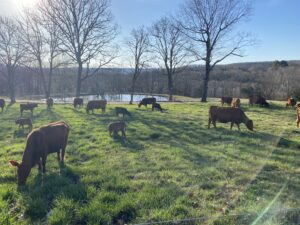
Rotational grazing was a large undertaking for Jane and James that required first establishing a diverse assortment of grasses and then ridding their fields of invasives or weeds. The natural history of Arkansas has a rich variety of prairie ecosystems, with grazing done by bison and ungulates primarily (www.uaex.uada.edu). The Maginots use this as a guide to design their rotational setup. For rotational grazing, evenly distributing waste products from their cattle and evenly grazing allows the paddocks to have time to recover. Each year they strive for a 300-day grazing window. Such a wide grazing period allows their cattle to be well-fed and happy through winter and keeps the Maginots from buying as much hay each winter as well.
For the Maginots, soil health not only requires sustainable grazing, but also sustainable input of nutrients. The chickens raised at the Maginot’s farm also provide litter for the rest of their products. To farm sustainably, all aspects of nutrient management are thought through, even down to the decomposers supported in their pastures. The soil directly benefits from this diversity and balance, which benefits the livestock and their owners. Producing healthier cattle with a year-round food supply has been a major win for the Maginots since applying these practices.
Soil health and water quality go hand in hand. For agricultural producers and farmers, soil health can save time and money for landowners. In the Beaver Lake watershed of Northwest Arkansas, clean water is vital as our community grows and continues to add importance to Beaver Lake, the drinking water source for 1 in 6 Arkansans. The Beaver Watershed Alliance can help landowners, farmers, and producers of any scale learn how to better manage soil and water to protect our vital natural resources. To learn more about the Alliance, visit our website, beaverwatershedalliance.org, or visit us on Facebook.
Citation: