
Project: The use of farm ponds with modified outlet structures to decrease peak flow and erosion in the West Fork of the White River
Timeframe: July 2019 – October 2020
Project Partners: Baylor University, University of Arkansas, Arkansas Water Resources Center, Beaver Water District, Walton Family Foundation
Project Overview: The use of farm ponds to control erosion is well documented. For example, the large expansion of farm ponds in Central Texas during from 1950-1970s decreased the sedimentation rates significantly (Berg et al. 2016). However, these farm pond systems tend to only have emergency outlets, that typically overflow during heavy rains resulting in increased peak flow and sedimentation rates downstream. In urban settings, the use of stormwater management ponds are a common practice to decrease peak flows caused by increased impervious landcover. Water is slowly released from stormwater management ponds through the outlet that can have different designs ranging from overflow, perforated or bottom draw (REF). Thus, adding these outlet designs to farm ponds can be beneficial to decrease peak flows and retain sediment.
Beaver Lake uses include recreation, flood storage, and provides drinking water for approximately 500,000 consumers in Northwest Arkansas (Miller and Daniels 2002). Given the importance of this reservoir, monitoring and managing the watershed will help to maintain and/or improve water quality. The three major tributaries of Beaver lake are Richland Creek, War Eagle Creek, and White River. The West Fork of the White River is on the 303(d) list, classified as impaired caused by high levels of turbidity that can cause decreases in dissolved oxygen (USEPA, 2017). One best management practice to control erosion is to create stormwater ponds that decreases the peak flow of rain events and captures sediment and nutrients. As the percent of pasture landcover increases so does the risk of soil erosion. Through adding farm ponds in these locations can decrease the peak flow by 17-20% depending on the dryness of the soil (Scott and Haggard, 2015) resulting in less erosion downstream and improving water quality.
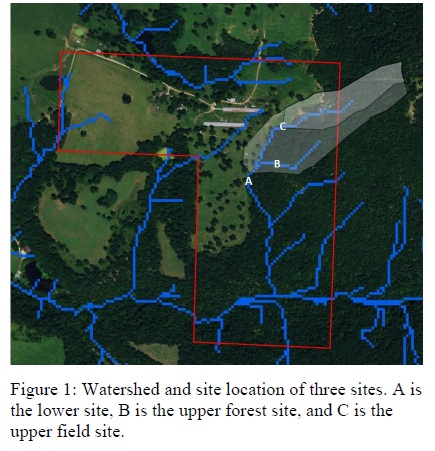
Here we investigated the use of a farm pond with a perforated outlet to decrease peak flow and retain sediments and nutrients in a second order stream in Northwest Arkansas that leads to the West Fork of the White River. To investigate performance of the pond we monitored the hydrology for 16 months prior to constructing a pond with a perforated outlet and then continued monitoring for an additional 12 months (at time of writing this report). In addition to the hydrological data, we also collected water samples both before and after pond construction and measured the total suspended solids (TSS), total nitrogen (TN) and total phosphorus (TP).
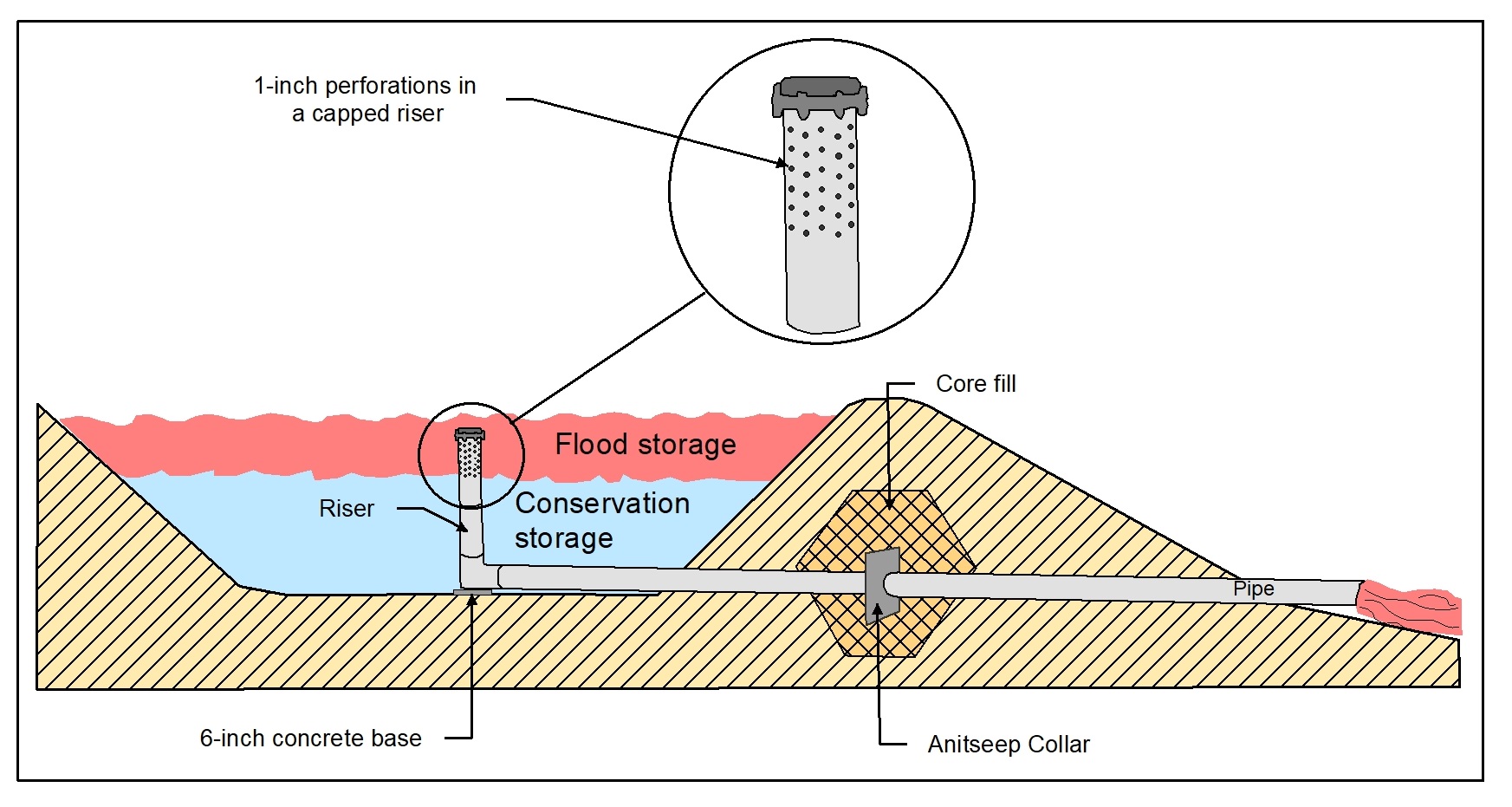
Cross section of a modified pond (Larry Berry, BWA, 2026)
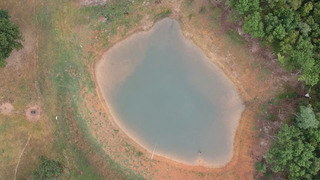
Aerial photo of pond installation (2017)
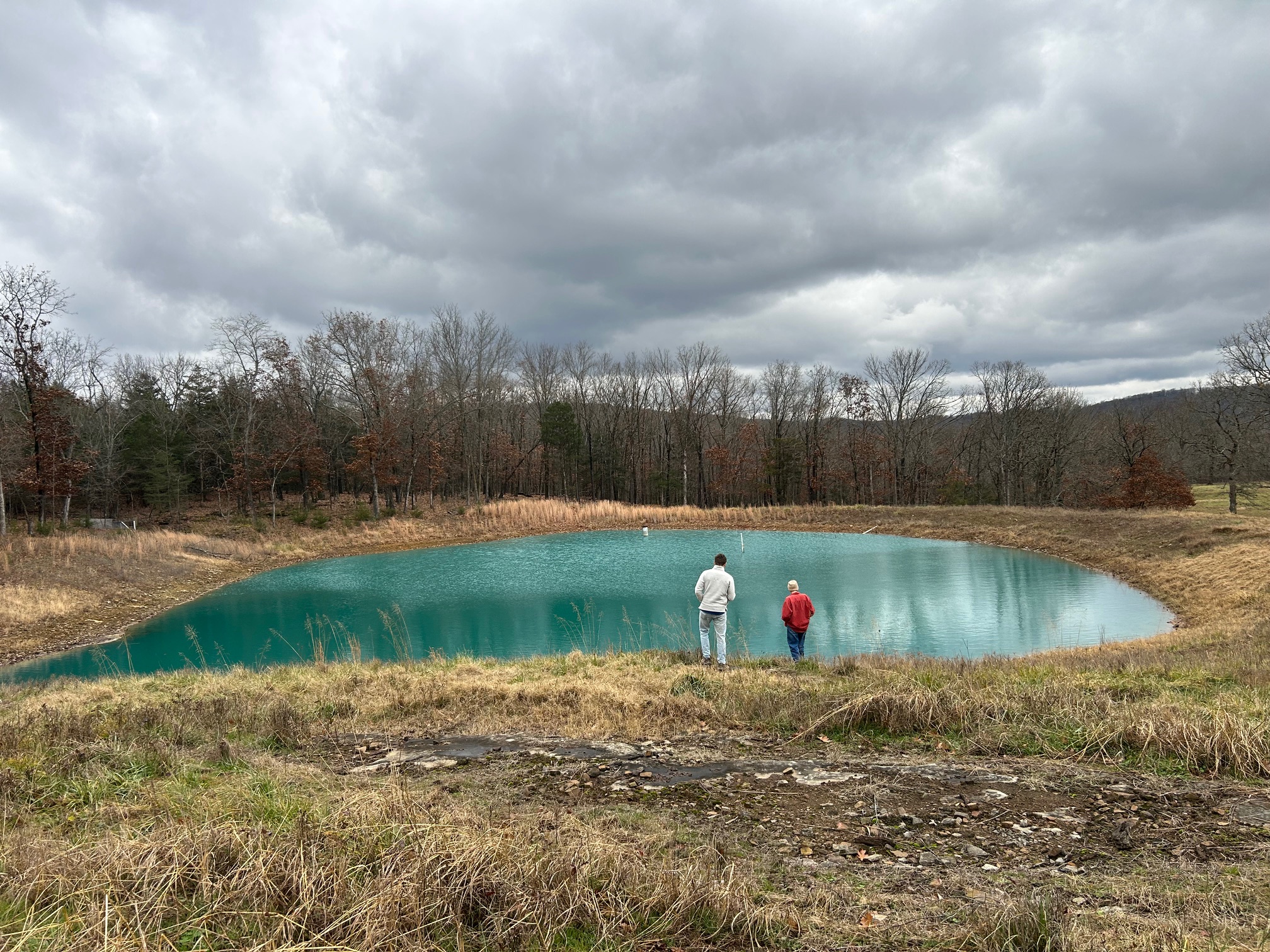
Established modified pond (2025)
Key Findings:
- Modified ponds decreased peak flow and promoted sediment retention downstream by preventing erosion during high flow events.
- Overall, after one-year post-pond construction, there was significantly improved hydrology by increasing the duration of each rain event and decreasing the peak flow.
- Installing ponds in elevated and severe hydrologic risk sub-basins can result in a 13 – 25% reduction in peak flow, based on average moisture conditions. Previous analysis suggested that the construction of only 22 ponds in the severe risk sub-basins could decrease peak flow by almost
15% – a solution to assist in the reduction of streambank erosion downstream in a basin. - Analysis showed river peak flow decreases by 0.52% for every new pond added at the outlet of a headwater sub-basin.
- Modified ponds can offer a source of drinking water for livestock by fencing off the pond and connecting an alternative drinker.
Reports:
Simulated use of ‘first-order’ ponds to reduce peakflow in an eroding river system
J. Thad Scott and Brian E. Haggard
Department of Crop, Soil, and Environmental Sciences, University of Arkansas, Fayetteville, AR; Arkansas Water Resources Center, Fayetteville, AR
*corresponding author: jts004@uark.edu
Wagner Scott- BWA Final report Sept 2020
The use of farm ponds with modified outlet structures to decrease peak flow and erosion in the West Fork of the White River
Nicole D. Wagner1 and J. Thad Scott1,2
Center for Reservoir and Aquatic Systems Research, Baylor University, Waco, TX, 76798
Department of Biology, Baylor University, Waco, TX, 76798
Recent Comments